In Thai culture, the number ‘9’ is not just a digit; it is a symbol of magical blessing. When director Sompot Chidgasornpongse tells the story of merit-making across nine temples in his first fiction feature, 9 Temples to Heaven, it ceases to be a mere family pilgrimage. Instead, it becomes a profound observation of human existence, time, and invisible institutional power.
The film begins with an ominous prophecy. 63-year-old Sakol learns that his mother’s life is nearing its end. As a remedy, he chooses a marathon journey of merit-making across nine temples, traveling from dawn until dusk. The family consists of nine members, each with a different age and belief system, creating a diverse internal world. They all set off together in a single van. However, the real conflict begins when the grandmother—the very foundation of the family—grows exhausted halfway through. This struggle isn't just about the physical road; it is a clash of philosophies between generations.
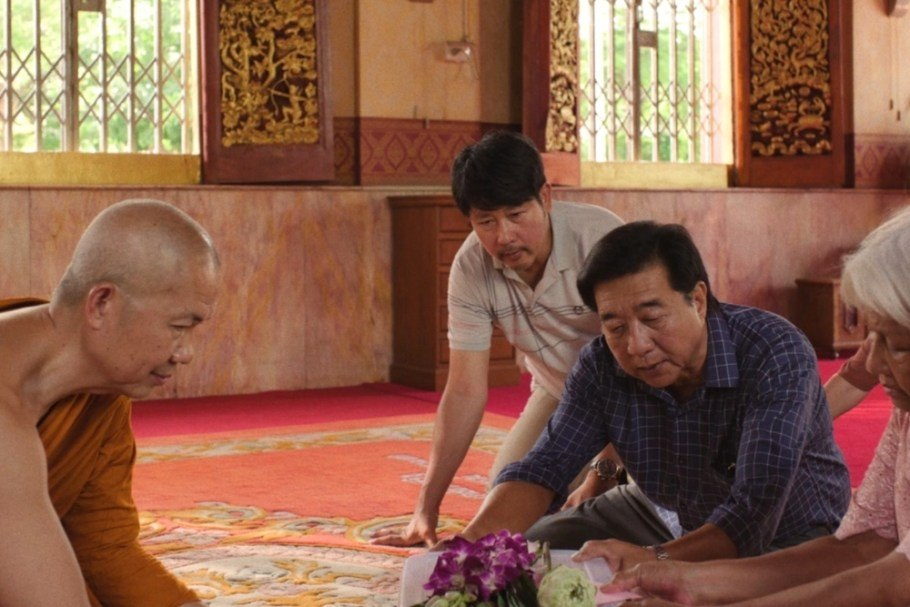
Sompot’s background as an architect frequently emerges in his cinematic frames. Here, the characters do not just tell a story; they navigate the massive architecture of the temples. Each person seems to carry their own world within them. Through the use of long takes and the structural beauty of the shrines, the viewer eventually feels like the tenth member of this family.
The mood of the film is dictated by the shifting light—from the deep blue of the pre-dawn sky to the midday glare, and finally, the candlelight of evening. Sompot uses this passage of time as a metaphor for the lighting and fading of hope within the human heart.
The wind blowing, leaves rustling, planes flying overhead—everything feels as though it is happening right here, right now. It doesn't feel like "movie reality," but rather a literal, lived reality. When a monk speaks, we hear him with a depth that is amplified by the visuals of the temple’s incredible craftsmanship. In those moments, one has no choice but to watch in a state of meditation.
The director skillfully shows how Thai Buddhism is intertwined with Hinduism and animism. For the elders, religion is a set of rituals and a guarantee of longevity; for the younger generation, it is merely a philosophy of life. Sompot portrays this tension with great empathy. Without proving any side wrong, he shows how religion and politics cast a shadow over our personal emotions.
The sound design is truly enchanting. The sound of the wind is captured so vividly that one can almost feel its touch. The cinematography is equally brilliant. Notably, the film grows stronger as it progresses. Toward the end, the sense of meditation deepens. The interplay of dreams, music, and light-and-shadow transports the audience to another realm.
Apichatpong Weerasethakul is the producer of this film—need one say more? Having worked as Apichatpong’s assistant, Sompot has brought a certain "meditative" quality to his own work. Yet, this remains a deeply personal experience born of collective living. 9 Temples to Heaven reminds us that the temple or the pilgrimage might not be the final destination. Instead, the real essence of life lies in the journey itself—in the subtle bonding and breaking that happens within a family, a phenomenon that is universal to all people and all places.
9 Temples to Heaven is a film that is simultaneously still and in motion. It is a meditative journey that continues long after the film has ended.