There is something quietly painful about the lies we tell for the people we love. Sometimes they begin as protection, almost harmless, and slowly become something much heavier. Michelle Zhou’s Big Little Things, which premiered at Venice, finds its emotional centre in that uncomfortable space between love, family and the impossibility of continuing to hide.
Returning to her childhood home in northeastern China for Lunar New Year, Lei knows exactly what is waiting for her. Her demanding mother expects a certain kind of life from her, and Lei has learned that some parts of herself are easier to hide than to explain. So she brings home a fake boyfriend to conceal her relationship with her girlfriend. What begins as a performance gradually becomes more complicated when the boundary between pretending and reality starts to disappear. Then her girlfriend unexpectedly arrives, and the little world Lei has constructed begins to fall apart.
The premise itself is familiar. The fake boyfriend, the family gathering, the pressure to conform, the hidden relationship and the inevitable confrontation have all appeared in different forms in cinema before. There are moments in Big Little Things when I did not necessarily feel that I was watching something I had never seen before. Some of its situations and emotional beats belong to a language that contemporary queer and family dramas have already explored. But familiarity does not necessarily make a film less effective. What matters is what it does with those familiar elements, and Zhou finds several moments of real strength within them.
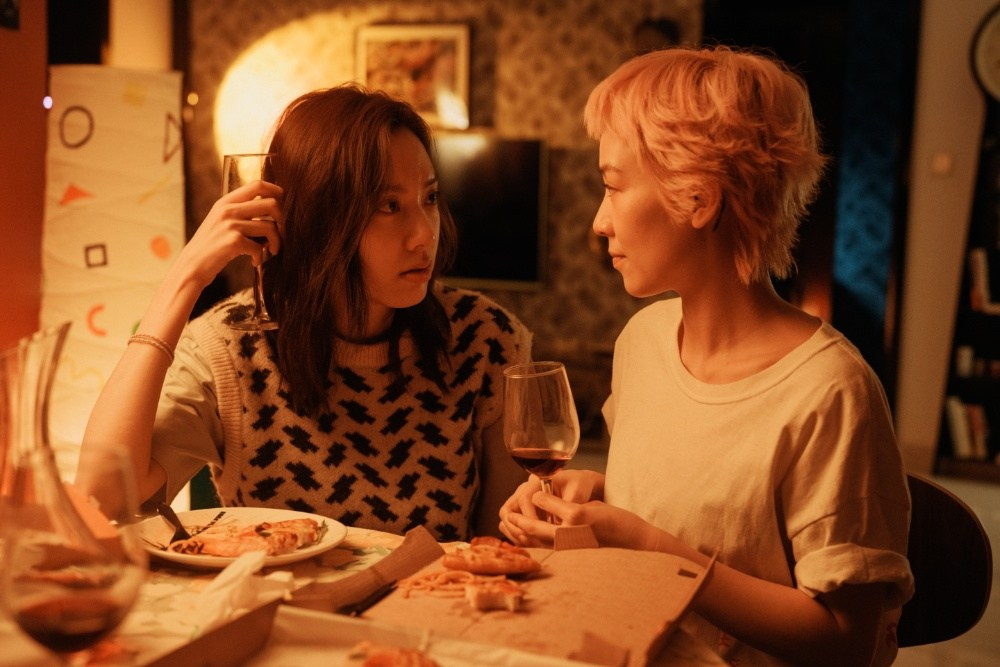
The Lunar New Year gathering becomes particularly important. What should be a celebration of family slowly turns into a confined space where everyone is performing a role. People eat, talk and behave as though everything is normal, while something much more complicated is happening underneath. The film understands how exhausting such performances can become. Lei is not simply lying to her mother. She is constantly managing everyone else's expectations, protecting other people's feelings while gradually losing the space to acknowledge her own.
Zhou describes this as the violence of silence, and that idea runs through the film without needing to be shouted. The silence here is not empty. It is full of things that people know but refuse to say, things they suspect but do not want confirmed, and feelings that have never been given the language to exist openly.
Some sequences are particularly strong in capturing this tension. The film can move from awkward humour to discomfort without making the transition feel forced, and there are moments when the emotional pressure inside a room becomes more powerful than anything the characters actually say. The best scenes are the ones where the performance of a happy family begins to crack but does not immediately collapse.
The personal history behind the film gives these moments another dimension. Zhou's partner, Chun, is also the producer, and Chun's father plays the father in the film. According to the filmmakers, he lived through a similar experience in real life. That makes the film's idea of confrontation more complicated than a simple coming-out story. Cinema becomes a space where something that could not be properly discussed within a family can finally be approached.
This is perhaps what separates Big Little Things from a straightforward story about a young woman hiding her sexuality. Zhou is less interested in treating coming out as one dramatic moment after which everything is resolved. Instead, she looks at what comes after the truth becomes impossible to hide. Can a family learn to know one another again when the version of each other they have been holding onto begins to disappear? The film does not always answer that question in the most surprising way, but it approaches it with sincerity. And there is a tenderness in the idea that healing might begin not through a perfect conversation, but simply through finally allowing people to see each other as they are.
The ending is particularly effective. Without giving away where it goes, it leaves the film on a note that feels both unexpected and fitting. After all the deception and emotional pressure, there is a sense of movement, as though the characters have finally stepped outside the roles they were forced to play. It is a cool ending, but more importantly, it gives some of the film's earlier tension a different meaning.
Big Little Things may not reinvent the family drama or the queer coming-of-age story. There are places where its familiarities are quite visible, and I sometimes wished it would push further into the strange and complicated territory suggested by its premise. Yet as a whole, it is a strong Venice entry, carried by several beautifully observed sequences and a genuine understanding of how family love can become entangled with fear, expectation and silence.
Perhaps the film's most affecting idea is also its simplest. A lie can begin as a way of protecting a family, but when it is kept for too long, it can become the very thing that keeps a family from knowing one another. Sometimes honesty does not destroy the family. Sometimes it is the first chance the family has to become real.