Few filmmakers make time feel as political as Lav Diaz. For nearly three decades, his films have asked audiences to remain with histories, landscapes and wounds that conventional cinema often passes over. His long takes and extended runtimes are not simply tests of patience; they are a way of making history tangible, of forcing us to spend time with people and places that history itself has often left behind. From From What Is Before, with its quiet rural community on the eve of martial law, to Norte, the End of History, The Woman Who Left and A Lullaby to the Sorrowful Mystery, Diaz has repeatedly returned to the Philippines' political and historical wounds. His films understand history not as something safely finished, but as something that continues to live in the land, in institutions, in religion, in poverty and in collective memory. That is what makes Let Us Through, Dear Ancestors such a fascinating continuation of his cinema. Following Magellan, Diaz goes deeper into the Philippines' colonial past, this time to 1617, when Spanish power was no longer simply arriving but beginning to establish itself permanently.
At 151 minutes, Let Us Through, Dear Ancestors is Diaz's shortest feature in 24 years, an almost amusing fact when considered alongside a filmmaker whose name has become so closely associated with monumental running times. Yet the film never feels like Diaz trying to make himself smaller. If anything, it is remarkable how much of his historical imagination he manages to contain within two and a half hours. The film centres on Padre Enciso, a Spanish friar and encomendero who exercises his authority through religion, violence, sexuality and economic exploitation. He oversees the construction of a church, while his son Dungwen is tasked with transporting the limestone needed to build it. What appears at first to be a simple practical assignment becomes increasingly dangerous as the stones have to pass through territories where Indigenous communities resist Spanish authority. The limestone must be extracted, carried and eventually transformed into a monument to Christianity, while the people whose labour makes that monument possible are subjected to dispossession, forced conversion and violence.
This is a distinctly Diaz-like way of approaching colonialism. He does not need to build the film around one spectacular battle or a single moment that announces the cruelty of empire. Instead, he looks at the work required to construct the physical symbols of colonial power. A church can be beautiful. It can be sacred. It can become an important part of a country's history and landscape. But it can also contain, within its stones, the history of forced labour, violence and death that made its existence possible. That contradiction is at the centre of Let Us Through, Dear Ancestors. Diaz is interested in the unsettling fact that colonial violence can eventually disappear from view while the structures created through that violence remain standing. The late sixteenth and seventeenth centuries saw the construction of churches, roads, ports, forts and other colonial infrastructure across the Philippines, much of it dependent on Indigenous labour. Diaz takes that history and turns architecture itself into evidence. The church is no longer simply a building or a backdrop; it becomes a physical record of what happened before it was built.
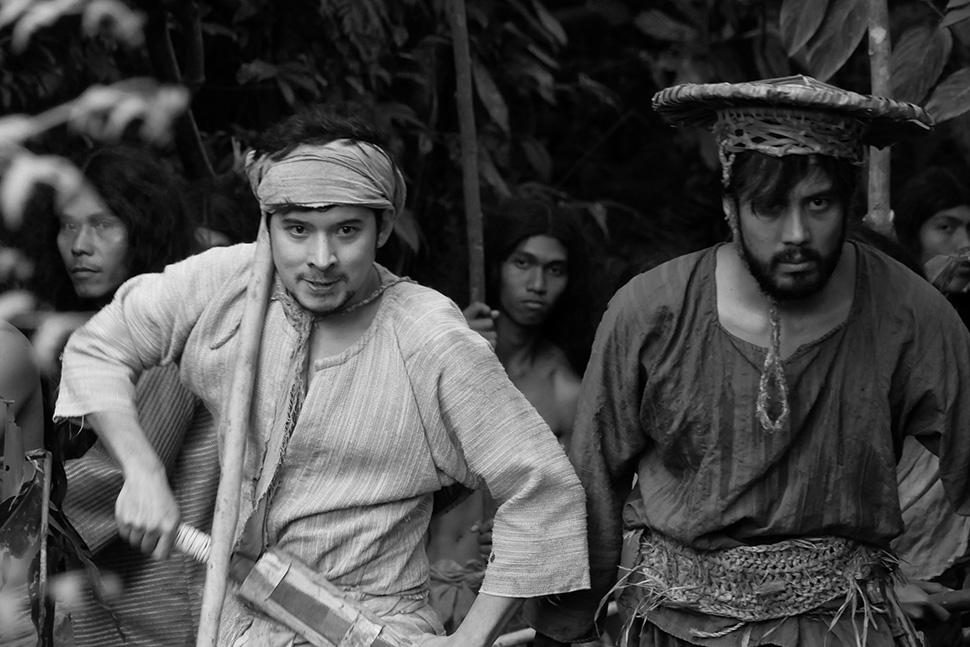
That idea also gives the film's title a particular weight. Makikiraan po is associated with respectfully asking permission to pass through places believed to be inhabited by ancestral spirits, and in Diaz's film the phrase feels like more than a poetic title. The ancestors are not safely confined to some distant past. They remain beneath the landscape, inside its structures and within the country's memory. The film itself seems to ask permission to enter that buried history, to move through the layers of time that separate the present from those who suffered under colonial rule. This becomes especially powerful through Babayeng Indimatandog, played by Isabel Sandoval. As a Babaylan, she represents a spiritual and cultural world that existed before Spanish Catholicism attempted to replace it. Her presence gives the film another rhythm, one connected to a belief system that colonial power could suppress but never completely erase. She does not merely function as a symbol of an older religion; she embodies a form of memory that survives despite the attempt to overwrite it.
Dungwen, meanwhile, gives Diaz a more complicated way of looking at colonial authority. He is connected to the system through his father, yet his work brings him into direct contact with the people suffering under it. He is not an innocent outsider, because he participates in transporting the material used to construct the colonial church, but neither is he simply another version of Padre Enciso. Through him, Diaz shows how systems of domination become sustainable not only through openly monstrous figures but through obedience, dependence and ordinary responsibilities. Someone orders the church. Someone extracts the stone. Someone transports it. Someone builds the wall. Someone eventually blesses it. Generations later, people may see only the finished monument, with little sense of the violence that went into making it. Diaz asks us to look backward through that entire process, to see the labour and suffering hidden inside something that history might otherwise present as beautiful or sacred.
This is where Diaz's approach to time becomes particularly important. His patient filmmaking is not simply an aesthetic preference; it changes how we understand what we are watching. People walk, wait, work and travel, and these actions are allowed to occupy time rather than being reduced to quick transitions between important events. The transportation of limestone therefore becomes more than a plot device. The labour itself becomes history. Calling Diaz a "slow filmmaker" can obscure this because his cinema is not slow merely because his shots are long. It is slow because he refuses to turn history into something abstract and easily consumed. There is something radical about giving ordinary actions the same attention that conventional historical cinema gives to battles, kings and political speeches. Diaz gives time back to people who have so often been reduced to footnotes.
The film's black-and-white imagery strengthens that sense of history without turning it into a museum piece. Landscapes, faces, walls and empty spaces have a severe, almost tactile quality, and Diaz allows them to exist without constantly manipulating them for dramatic effect. His involvement as writer, director, cinematographer, editor and production designer gives the film an unusually unified visual and formal character, as though the entire world has been patiently excavated from the past rather than conventionally reconstructed for the screen. Yet what makes the film most compelling is that its politics never become detached from this physical world. It is about colonisation, but also construction; about religion, but also labour; about faith, but also material; about history, but most importantly, about what remains after history is supposedly over.
Spanish colonialism changed not only what Filipinos were taught to believe but also the landscape in which they lived. Churches, roads, ports and other structures became part of the physical reality of the country. Empires disappear, governments change and the people responsible for violence die, but buildings remain. That permanence is deeply unsettling in Let Us Through, Dear Ancestors. The church becomes a reminder that colonialism is not simply something that happened centuries ago. Its traces remain embedded in the world. Following Magellan, Diaz therefore shifts his attention from the first encounter between Europeans and Filipinos to what comes after it: the consolidation of power, the transformation of conquest into administration, violence into routine, religion into authority and temporary domination into permanent architecture.
And yet the film never feels like a history lesson. That may be one of Diaz's greatest strengths. He trusts the landscape, silence, actors and time, allowing the viewer to discover connections rather than explaining every idea for us. Even the film's unusually short runtime does not feel like a concession to modern attention spans. Diaz's films are as long as the material requires them to be, and here the material requires 151 minutes. The fact that this is his shortest film in 24 years is interesting not because Diaz has abandoned his methods, but because it reminds us that duration was never the real point. The point was always what he could make duration do. His films can take hours because history itself takes centuries, but he can also compress that historical consciousness when the film demands it.
What makes Let Us Through, Dear Ancestors ultimately so powerful is the way it refuses to separate beauty from horror. The church can be magnificent, the landscape can be beautiful, the rituals can be hypnotic and the images can be serene, while beneath all of them lies violence. Diaz does not use beauty to soften history; he uses it to make us look at history more carefully. The film asks what it means to inherit a country shaped by conquest, who gets remembered and who gets erased, and how violence becomes invisible once it has been transformed into institutions, traditions and monuments. In that sense, Let Us Through, Dear Ancestors feels like another chapter in Diaz's long attempt to understand the Philippines not as a finished nation but as a place carrying layers of unresolved history.
It may be one of Lav Diaz's shortest films, but it certainly does not feel smaller. Its 151 minutes contain the same enormous historical imagination that has always made his cinema so singular. He continues to make films that ask us to stay; not simply with a story, but with a people, a landscape and a history that refuses to disappear. For Diaz, the past is never really past. It is still standing, embedded in the world around us. Sometimes, it is standing in the form of a church.