Angela Schanelec. One of the most unique voices of contemporary cinema. And it's always mysterious how she looks at people. She does not seem interested in explaining them, even when their lives offer every reason for an explanation. In her latest feature film, My Wife Cries (Meine Frau weint), she begins with a simple, painful situation: a woman calls her husband from a hospital and asks him to come and get her. Thomas arrives to find Carla crying. She has survived a car accident, but David, her dance partner, has died. What follows is not quite a story of grief, nor is it simply a story about a marriage coming apart. It is a film about the strange distance that can emerge between two people who share a life but cannot necessarily share what is happening inside them.
Carla wants to speak. Thomas, however, seems unable to meet her where she is. Her grief has entered their marriage, but it does not automatically become something they can experience together. The more Carla attempts to make sense of what has happened, the more Thomas appears caught in his own silence. Schanelec observes their encounters without offering the familiar comforts of a marital drama. There is no easy division between the person who suffers and the person who fails to understand. Instead, the film leaves us with the uncomfortable possibility that love, even when it is present, may not be enough to make another person's pain accessible to us. We can sit beside someone, listen to their words and still remain somewhere outside their experience.
Schanelec's direction is extraordinary precisely because she seems to have no desire to hurry towards meaning. She allows scenes to unfold at their own pace, giving ordinary gestures and conversations a duration that cinema rarely grants them. A pause becomes as important as a sentence; a look can remain unresolved long after we expect it to tell us something. The film has a secretive quality, as though its characters are living with truths that even they cannot fully articulate. Yet this secrecy never feels like a puzzle waiting to be solved. Schanelec does not hide information merely to surprise us later. She creates the feeling that human beings are, to some extent, unknowable, even to those who live closest to them. The film's slowness grows out of this understanding. It asks us to stay with people without demanding that they reveal themselves.
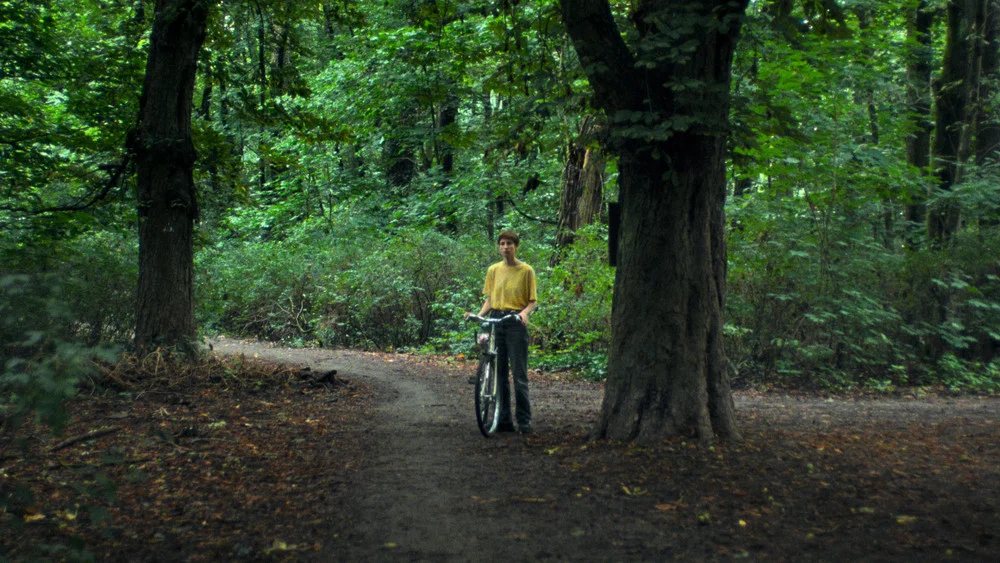
The cinematography deepens this feeling of quiet uncertainty. Schanelec's compositions possess a striking clarity, but the images never seem to surrender everything they contain. The placement of bodies within a frame, the space left between people and the stillness of the camera all contribute to a world that feels both intimate and distant. There is beauty in these images, but it is not the sort of beauty that decorates the characters' suffering. It comes from the precision with which the film looks at them. We are given time to notice the spaces they occupy, the moments when they fail to connect and the small changes that might otherwise disappear beneath the movement of a conventional narrative. The camera does not chase emotion. It waits, and in waiting, it allows emotion to arrive in unexpected forms.
What makes My Wife Cries so affecting is that it never pretends to possess the final word on grief or marriage. The accident may be the event that sets everything in motion, but the film's deeper concern is what happens afterwards, when life must continue and the people involved have no clear language for what has changed. Thomas and Carla are left to inhabit the same world with different understandings of it. Schanelec does not rush to reconcile these differences or turn them into a dramatic conclusion. She trusts the spaces between events, the unfinished conversations and the feelings that remain suspended after a scene has ended.
Watching the film feels like being allowed to stand at the edge of someone else's private life, close enough to sense its pain but never close enough to claim complete understanding. Its beauty lies in that distance. Angela Schanelec makes cinema out of what remains unsaid, and My Wife Cries lingers because it understands that sometimes the most profound things between people are precisely those they cannot tell each other.