What happens when faith becomes a commodity, death becomes a daily reality, and stealing turns into a strange form of caring? Mikel Gurrea’s Sants (Saints), which premiered at San Sebastian Film Festival, begins as a crime story but gradually becomes a film about grief, belonging and the desperate need to believe in something when life offers little certainty.
At the centre is Lali, a young woman facing her mother’s terminal illness. One day, she enters a church and approaches a small statue of a saint. Overcome by grief, she begins to cry uncontrollably, eventually driving the church’s only other visitor away. When she regains her composure, Lali takes the statue from its pedestal and hides it in her large shoulder bag. This impulsive act sets her on an unexpected path.
Through an acquaintance, Lali tries to sell the stolen object and meets Rosario, the charismatic leader of a gang dealing in religious artefacts. Played by Eulàlia Ramon, Rosario quickly gains Lali’s trust and even becomes involved with her dying mother. The group is more than a criminal organisation: it resembles a strange alternative community, stealing saints from churches and cemeteries and using the proceeds to help people facing serious illness.
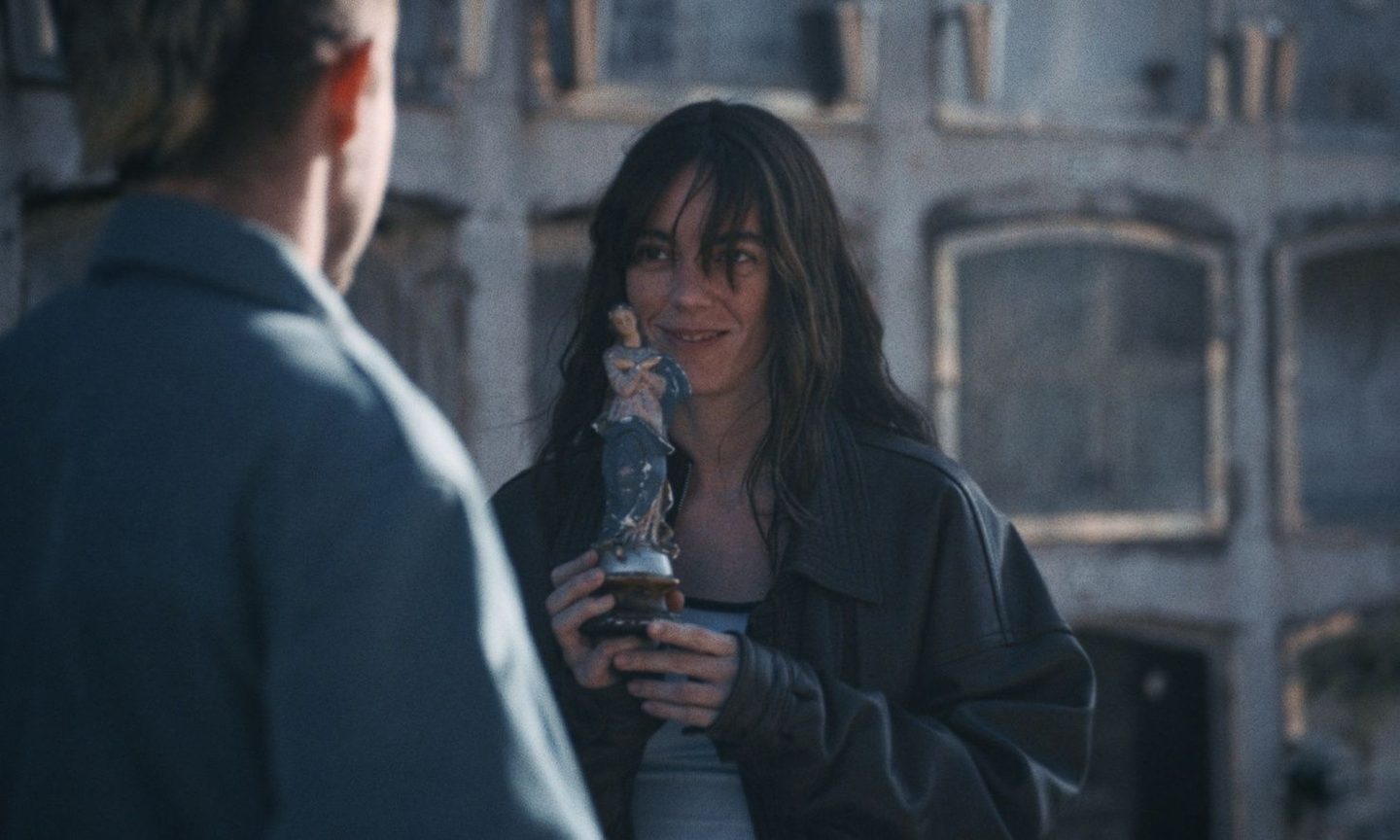
This contradiction lies at the heart of Gurrea’s film. The gang profits from religious faith while using that money to create hope. They rob churches in deeply Catholic Spain, yet their actions are not presented simply as greed. As Rosario points out, the country will never run out of churches. There will always be saints to steal — and people desperate enough to need them.
The heists provide the framework of a crime thriller, but Gurrea is less interested in the mechanics of robbery than in what Lali is searching for. As her mother disappears from her life, she is also looking for a new sense of belonging.
Victoria Luengo gives the film its emotional centre. Known for her recent appearances in Pedro Almodóvar’s The Room Next Door and Bitter Christmas, Luengo delivers a remarkably expressive performance. Her face becomes a map of Lali’s inner life: a glance, a movement of the mouth or a sudden change in her eyes can reveal a thought before she speaks. She plays a woman who is uncertain about what she wants but increasingly unwilling to remain passive.
This makes her relationship with Rosario particularly compelling. Rosario offers Lali something her biological family cannot: a community with its own rules and rituals. The gang’s activities are illegal, but within their peculiar moral system there is also loyalty, generosity and tenderness. Rosario is neither a conventional criminal mastermind nor a saint, and the film is strongest in this morally ambiguous territory.
Gurrea’s visual language deepens that ambiguity. Seemingly minor details acquire symbolic weight: a black-and-white film playing on television while Lali’s mother talks about the death of her father; the careful movement of Lali’s hands before another theft; the monumental curves of a modernist church. These images give the film a tactile quality, making statues, architecture and human bodies part of the same visual language.
As a result, Sants avoids becoming either a conventional social drama or a straightforward crime film. Gurrea creates a Barcelona where sacred and criminal spaces overlap, and where objects that have carried centuries of belief can suddenly become commodities.
The irony of stealing saints is impossible to miss. The gang takes figures of faith away from churches while trying to give sick people something to hold on to. Their business depends on belief even as they turn it into merchandise. Gurrea does not resolve this contradiction; instead, he allows it to define the film’s moral landscape.
Crucially, Lali is never reduced to a grieving daughter. Her mother’s illness is the emotional pressure surrounding the story, but Lali remains angry, selfish, funny and fiercely independent. Her attraction to the gang is driven not only by money but also by rebellion and by the possibility of finding people who understand her.
With Sants, Gurrea turns a story about stolen religious statues into an intimate film about grief, freedom and the human need for hope. Its saints may be stolen, sold and stripped of their sacred meaning, but the people surrounding them continue to search for something they can believe in. In a world where faith is constantly being bought and sold, Lali’s real journey is toward something much more difficult: learning to trust herself.
“Saints” premiered at the San Sebastian International Film Festival 2026.