The film opens with footage from a single parliamentary session on June 10, 1993. When did you first encounter this recording, and what was it about that specific day that told you a film was waiting to be discovered inside it?
Some years ago, part of this recording was brought to my attention while I was working on a different film, which also concerned the monetary policy of the country but had a wider dimension. When I revisited it, along with other recordings, I discovered how lively these parliamentary sessions were at that time. It's important to know that this is 1993. Georgia had become independent a year and a half earlier, in December 1991. So everything is very fresh: the process of creating a new state is in its beginning phase. Naturally, the discussions in the parliament were about creating the premises for this new, modern state.
I revisited the recording last summer, and watching it, I connected it to what is happening in Georgia now, where the government is growing more and more like Russia and introducing Russia like laws. So that time of self identification connected to the current question of who we are as a society, as a country.
What interested me about that particular day was, first of all, seeing how diverse the parliament was, and then how a topic so pivotal in the history of Georgia was discussed in a way that was both charged and reluctant. A decision was made that affected millions; in a country of 3.5 million people, it really affected the whole population. Of course, this was just a detail of a bigger picture. It's not one occasion that changes the fate of a country, but alongside other details it contributed very much to what happened in the years to come, and to the way we are as a country right now.
You chose to let the archive speak entirely for itself; without modern interviews, commentary, or a guiding voiceover. What drew you to such a quiet, trusting way of storytelling?
I'm not sure how trusting it is, because it's just a fragment. Not only in Georgia but everywhere, the historical record is very arbitrary. And the 90s were extremely intense times. There is no true record of them. One historian might say one thing, another historian something else; one witness might say one thing, another witness another. And they're all right and not right at the same time. It's very difficult to construct a full picture of what happened. That time was also full of crime and corruption, and none of the people involved have ever been punished or prosecuted, or even acknowledged. Their crimes have never been acknowledged publicly.
So I cannot claim what is right or what is wrong. I cannot investigate. I would love to, actually, but it's a totally different kind of job. So let's offer a fragment: a look through a peephole, into a tiny crack where we see a glimpse, a detail of a fuller picture, and maybe try to imagine the reality of the time. Of course, that imagination can be subjective as well. But let's look into this crack and see what's there. I see this film as looking at a freeze frame in time, a freeze frame that is part of something much bigger.
The debate over the kuponi reflects a country in the middle of a delicate, uncertain transition. How did you immerse yourself in the historical context of that period, and did your own understanding of those days evolve as you spent time with the footage?
To immerse myself, I spoke with several people, mostly journalists who were active at the time, to understand the situation in more detail: who is who, what background they have, where they come from, what their stance was. I also personally remember those parliamentary sessions. They were on TV in almost every family; everybody was watching. I remember the images very vividly. I was 12.
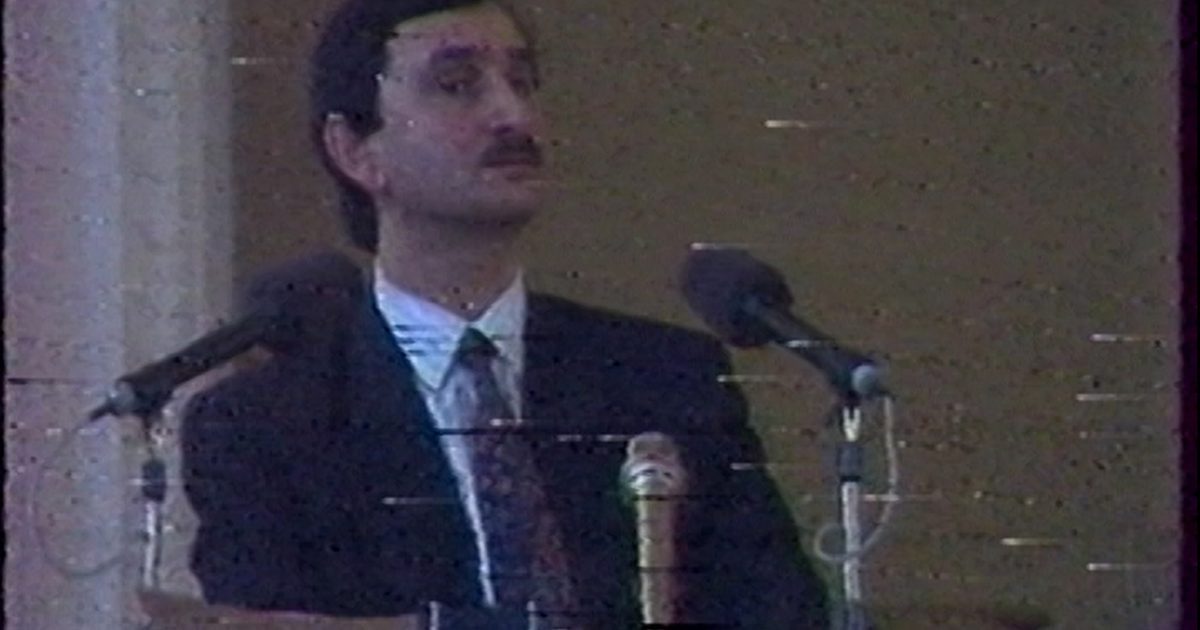
So it was mostly conversations with others, to understand the details, not so much the economic or financial side but the social and political side. Even if the film concerns the introduction of the first national currency, the economic details were less important to me. The talk about the currency is more of a premise, a way to see how the process of democracy works, how the process of founding a state works. It was a lot of work, actually, to identify some of these members of parliament. Some are prominent figures; others have not been seen or heard of since. So it took research to find out who they are.
How did my understanding evolve? A lot, actually. In Georgia we like to blame some people for our misfortunes, and many of the figures who appear in these proceedings are seen as villains, and some indeed are villains. But what I discovered was that the process of laying the foundation of a state was also an honest aspiration for some people. This honest desire to do something, to be a participant in the process, this eagerness, was something I hadn't really thought of before. I probably had a more stereotypical understanding of some people: that somebody was corrupt, somebody didn't care, somebody had only personal motivations. Instead, I found a genuine desire to participate and be part of something bigger than themselves. That was a discovery.
Only six hours of the original twelve-hour session survived, making the archive inherently incomplete. How did you navigate those missing hours in the edit room, and did those silent gaps begin to shape the rhythm and meaning of the film?
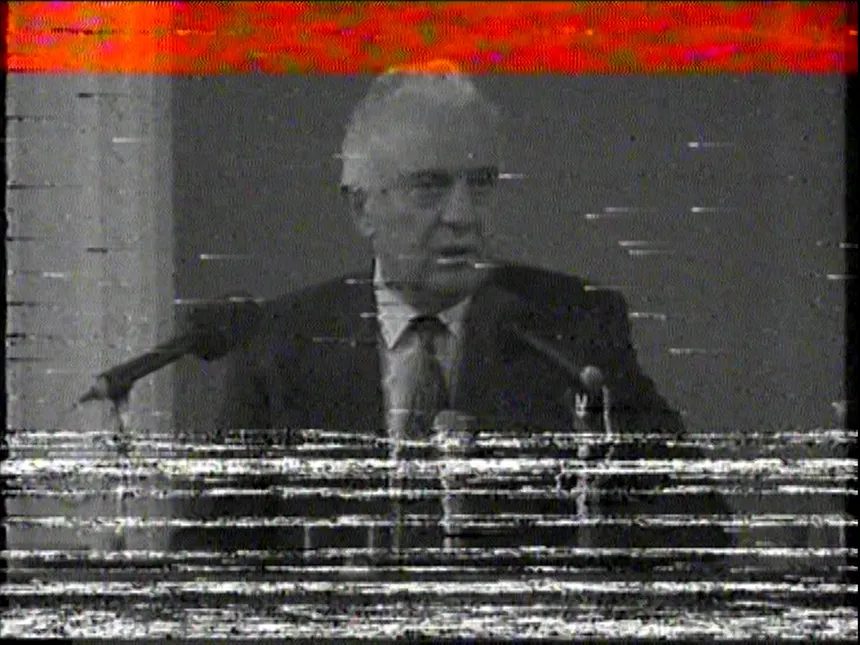
The first tape is probably the most coherent. It starts, then there is a break, which means something is missing: the speech of Eduard Shevardnadze is cut, both in the digitized version and on the tape itself, as far as I understand. Then the session continues. The second tape is much more fragmented. There was a much bigger discussion in the second half of the session, with more topics coming in that addressed the economic crisis.
This was reflected in the film. The film starts as an actual parliamentary session, with the same rhythm: the beginning is almost uncut. Then we cut a bit, but it still resembles the original recording. That was the idea. Then, as the information on the tapes becomes fragmented, the editing also becomes fragmented, especially in the last part, which is much shorter than the first. I have a stenogram of this session, and I know there was much more going on, but it's not in the recording. So you see only glimpses, fragments of the topics that came up in the second part of the session. They creep into the film partially. We might not know exactly what they mean, but hopefully they evoke the idea that there were other difficulties accompanying the introduction of the kuponi.
The incompleteness, not just of the tapes but of the historical record, of the evidence of that time, translates very much into the title of the film. In this case, as probably in every film, the title becomes part of the content and defines what the film is about.
Rather than hiding the tape’s wear and tear, the glitches and visual decay become part of the film's atmosphere. Was preserving that fragility an intentional artistic decision from the beginning?
Yes, absolutely. You might see the glitches in a historical recording as an obstacle, because the footage is imperfect and difficult to watch. But for me, every obstacle is a possibility. That's how I try to look at the obstacles I encounter in filmmaking: if there is an obstacle, let's embrace it and let it become part of the film. That's how the glitches became part of the story, not just broken footage.
What they tell me is that the picture is not complete; there was something more which is no longer visible. Even recent history, which has just happened and is still in living memory, has no full record. As I mentioned earlier, we can only see through the cracks, through little peepholes. It's impossible to reconstruct the full image.
The glitches also show what was happening with tapes at the time. In the 1990s there was not enough money in the country to buy enough VHS tapes, at least not at the public broadcaster. Tapes were used, reused and re-recorded, so some important recordings disappeared. Anyone who has worked with VHS knows that when you re-record, a little material from the earlier recording sometimes remains and appears as a glitch. Suddenly you see a world behind the recording. You realize there was something there before that has disappeared, but you can notice a detail of it, a sudden glimpse. That was also the idea behind embracing the glitches, along with the acknowledgement that hardly anything is kept, even from recent history.
And there was a moment when the damaged tape became really difficult to watch. When we were editing, our eyes were hurting, and we asked ourselves: what do we do with the audience? Is it fine that they will also have difficulty watching? We needed a solution, especially for the part where the president of the National Bank is speaking. So we came up with a creative solution: we slowed down the real time. There is another part, during Eduard Shevardnadze, where we also used slow motion. On the one hand it lets us convey the material without total eye damage; on the other, it contributes to the film itself, to the concept of looking through a freeze frame.
As the debate unfolds, the room seems to expand into an intimate portrait of an entire nation navigating uncertainty. Was capturing that larger emotional portrait something you envisioned early on, or did it gently surface while editing?
I agree that it expands into a portrait of a moment in time in the country. Maybe it's not really an intimate portrait of the whole country, because what was happening outside was so multilayered and complex; it's not easy to grasp at all. But this has always been the case with my films: I'm attracted to taking one particular view, one detail, and expanding it into something that represents something much bigger. That was the intention of this film from the very beginning: to give a glimpse, or at least a feeling, of what is happening beyond the walls. Being confined to this one room is exactly what attracts me, and what I personally find valuable in this film. This confined space speaks about a much wider picture.
With the editor, we considered how much external context we could bring in. But the 90s in Georgia were so charged, so multilayered and complex, and also very subjective. Ask any Georgian of that generation and you might get totally different answers, because there is no agreed chronicle of events, no agreed reality of the time. Every layer I brought in, for example through text, would add a subjective view, and that was not the purpose of a film that sticks as close as possible to very raw material. Even with the titles at the end of the film, which give a couple of facts we found important, I was very careful to be as objective as possible, and to include the ambivalence as well.
And you're right, it is an emotional portrait: of the state of being at that time, which is a kind of chaos, something in the process of being made. But it's also a factual portrait.
I also wanted to speak a little about the decisions we made about the sound. The recording is mono, and not of the best quality, as you can probably judge from the images. I did the sound editing with Vano Arsenishvili, a friend and colleague who is also a filmmaker, cinematographer, editor and sound editor. We did a test screening in a cinema with mono sound, because I wanted to keep the authenticity of the recording, as we did with the images. But watching the cut in the cinema, it felt as if we, the audience, were sitting in that chamber, and that required us to be more immersed in the space sound wise. So I went to the sound designer, I would say the sound master, in Georgia, Paata Godziashvili, and he created the 5.1 surround sound, which I honestly find beautiful. Watching this degraded material while being immersed in the space adds real value to the film. It creates a space for the audience to be in that moment of 1993, to be less distanced from the room and rather part of it, and to imagine even more of what is happening outside.
Taming the Garden examined power, ownership, and landscape through a very different cinematic lens, while this film turns toward an institution and its paper trails. How do you see these two works conversing with each other in how they look at power and the forces shaping people's lives?
Taming the Garden, which came out in 2021, does examine power and power structures and the current state of Georgia. It was not made as a directly political film, but by and large it is political; of course, everything is. It played a huge part in Georgia in recent years. It was not released in cinemas, and it was removed from one of the big screens, so we organized many small screenings, with very diverse audiences. In Georgian the film is called just “Taming”, and the word became, if I'm not exaggerating, a cult word. People would say, “You cannot tame us, we're untamable,” and when the government attacked culture, people spoke of “taming the culture”. The word was used a lot, sometimes referring to the film, sometimes not. There is also an earlier work of literature by the well known Georgian writer and thinker Akaki Bakradze, called The Taming of Literature, about how Georgian literature was tamed, or polished, during Soviet times.
Taming the Garden definitely had a cinematic lens, and that is the way I work. Usually I film myself, or with someone who shares my vision, and the construction of the image is a primary part of my process. Image is the content; image is everything. Here, of course, it's a very raw parliamentary session. Image wise it's totally out of my control, and very limited: there are several parliament cameras and the framing is not diverse. But it also investigates power structures, and in that sense it absolutely resonates with Taming the Garden. Honestly, I had not thought about it until now; I'm thinking as I'm answering. But they do converse.
After Taming the Garden I was thrown onto a stage, onto a front line. This was when the government started to repress people, cultural organizations, courts and various institutions, turning its back on the EU becoming more like Russia and passing Russia like laws. Taming the Garden was very much part of this process. People referred to the film, and I also felt a responsibility to use it to speak about the wider political context in Georgia. I appeared in front of a huge demonstration of a hundred thousand people, I was often on TV, I gave international interviews. Together with colleagues I also started DOCA, the Documentary Association Georgia, to try to sustain documentary filmmaking in Georgia. So Taming the Garden really changed my life, or the course of my work. It brought responsibility, but also pressure: what kind of film should I make next? Should it be as big and ambitious as Taming the Garden, which was a really long shoot? And after the full scale invasion of Ukraine, I wasn't sure what kind of film I could make in such a difficult situation. I thought: I cannot make another film right now, I cannot raise funds, this is not the time.
I think this film, An Incomplete Day in the History of Georgia 10.06.93 is a response to all that. It's a very low budget film, made with development funding from Chicken & Egg Pictures that I received three or four years ago. I used only that funding and didn't raise more. It's minimal in its resources and in its source material. While Taming the Garden was made for both Georgian and international audiences, this film zooms into the Georgian context and responds to it, both now and thirty years ago. My main target is Georgian audiences, or anyone interested in this process: to understand where we come from, to question how power structures are created and how we all participate in them. And the question of responsibility, which is heard so much in the film: who is responsible? Who is responsible for what happens in Georgia now, for what we see in Taming the Garden, for what happened in the 90s? For me, the answer is that we are all responsible. We are all taking part in the making of the state, even those who don't speak, even those who don't do anything.
Documentary cinema has a way of honoring memories that traditional histories might overlook. What can a filmmaker draw out of an archive that a historian’s account might miss and what do you hope younger Georgians, who never lived through 1993, will feel when they sit with this film?
I don't want to generalize; I can only speak about this film. Historians, I guess, speak about facts. I'm more interested in the state of being: in the process, in the subtleties, in between the lines, in the glitches, the cracks and the peepholes, in what we don't usually see. This is how I try to work in my films: not just to film, but to catch something we don't usually see. A detail, a sudden breath, a sudden movement that might not mean anything directly but has a connotation. So here too, it was not about retelling the historical account, but about conveying the subtleties, the feelings, the emotions, the state of being of the moment. Maybe that's the best word. That is probably the difference, but I cannot answer for all documentary cinema. And for me, it's certainly not just about honoring memory.
As for younger Georgians, I hope they will understand where we come from as a society. The question of society is very important to me, not just in Georgia but everywhere. We are all part of a wider society in this world where, as I mentioned earlier, even doing nothing contributes to the state of the world. Being part of a society also means understanding your role, your mission, what you can do, small or big. So I hope, not just for younger audiences but for others too, that the film helps them understand where we come from: how some people took on this responsibility well or badly, how some benefited from it and others sacrificed themselves to it. Both are true for different people. And how hard the road was for us, as a society, to stand on our own feet. It still is a hard road. Making a society, or a country, functional requires effort, not from one, two or three people, but from many, very diverse people.