A beauty salon is supposed to be a place of transformation. People come in hoping to leave something of themselves behind; to look younger, healthier, more beautiful, or simply a little different from the person they were when they walked through the door. In Nathalia Acevedo's Salón de belleza, that familiar idea slowly turns into something much more unsettling. Adapted from Mario Bellatin's 1994 novel, the film follows an unnamed hairdresser, played by Sam Louwyck, who runs a salon in a city gradually being consumed by a mysterious illness. As people fall sick and are increasingly abandoned by the outside world, the salon begins to take in those who are dying. A place once devoted to appearance becomes a place where appearances no longer matter, and where bodies that can no longer be hidden are simply allowed to remain.
Acevedo is careful about how she brings about this transformation. She gives us very little information about the illness, the city or even the world beyond the salon, and that refusal to explain everything gives the film an eerie, almost timeless quality. The people who arrive are not conventional patients, and the hairdresser is certainly not presented as some heroic figure who can save them. He simply lets them stay. There is something both compassionate and disturbing about this arrangement. The salon cannot cure anyone, but it offers a space to those who have been pushed outside society, allowing them to exist when everyone else has decided they are no longer worth looking at. The horror of the situation therefore comes not only from the disease itself, but from the indifference surrounding it.
The aquariums filled with fish provide some of the film's most memorable images. They are beautiful and hypnotic, but there is also something deeply claustrophobic about watching the fish endlessly move inside their confined spaces. Their existence begins to echo that of the human bodies around them, which are increasingly trapped by illness and physical decline. Acevedo does not insist on explaining the symbolism, and thankfully so. The fish simply become part of the film's strange visual world, where beauty and decay are constantly occupying the same frame. Water, bodies, illness and confinement begin to blur together, creating an atmosphere that feels more like a dream or fever than a conventional narrative.
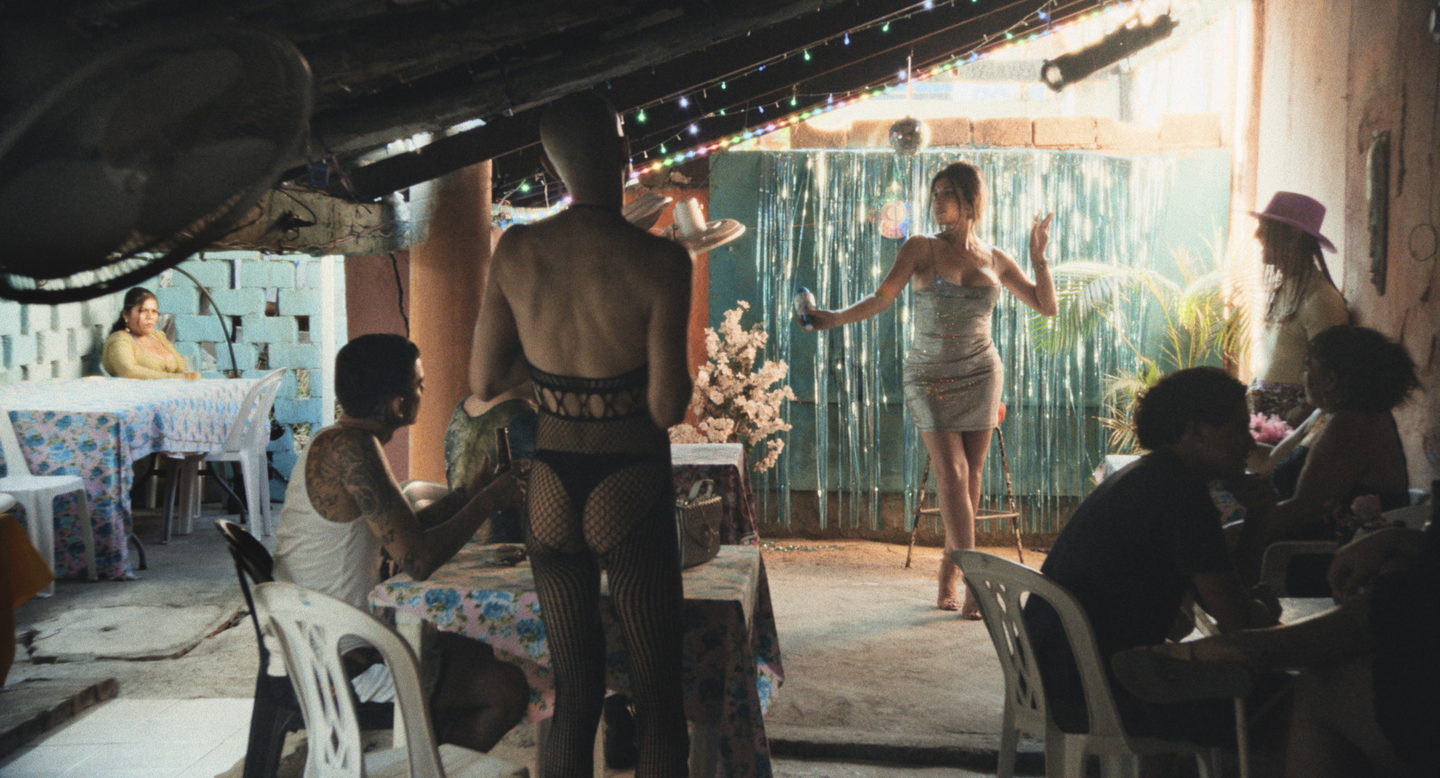
Sam Louwyck is particularly effective as the hairdresser. His performance is quiet but imposing, and there is always something difficult to read in his face and behaviour. He never feels like a traditional protagonist who is supposed to guide us through the story. Instead, he seems almost inseparable from the strange environment he has created around himself. The arrival of Juan, played by Erwan Kepoa Falé, introduces another dimension to this enclosed world: desire. Their relationship brings intimacy and attraction into a space increasingly dominated by sickness and death, adding another layer to the film's fascination with the body. Here, the body can be desired, touched, beautified, diseased and eventually destroyed. Acevedo never treats these as completely separate states.
That is perhaps the film's most compelling tension. A beauty salon normally exists to conceal imperfections—to make the body appear healthier, younger or more desirable. Acevedo turns it into a place where there is nowhere left to hide. The people inside have to confront illness and mortality directly, while the rituals that once gave the salon its purpose gradually become meaningless. Yet Salón de belleza does not suggest that beauty simply disappears. Instead, it finds another kind of beauty in intimacy, care and the simple act of allowing someone to remain present at the end of their life. There is tenderness here, but it is never sentimental.
The film can certainly feel elusive, and some of its choices may create distance. Its dreamlike structure and refusal to explain its world demand a certain patience, while some of the symbolism occasionally feels more prominent than the characters themselves. But that strangeness is also what gives Acevedo's film its identity. She is not interested in making a conventional epidemic story, nor in producing a straightforward adaptation of Bellatin's novel. She creates something suspended between reality, memory and nightmare, where the logic of the outside world gradually loses its importance. The salon becomes its own isolated universe, with its own rules and rhythms.
There is a quiet cruelty at the centre of the film's premise. The salon begins as a place where people come to change how they look, and ends as a place where people arrive when there is nothing left to change. That transformation could have been played as pure bleakness, but Acevedo finds something more complicated in it. Even as the body deteriorates, companionship remains possible. Desire does not disappear simply because death is nearby. And caring for another person, even when there is nothing that can be done to save them, becomes meaningful in itself.
Salón de belleza is not an easy film, and it does not try to make itself one. Its images stay with you more than its explanations do: the fish moving silently through the water, the confined spaces, the fragile bodies, the strange intimacy of the salon. Acevedo takes a deceptively simple premise and turns it into something much more peculiar; a film where beauty and ugliness, desire and illness, abandonment and care are constantly touching each other. Perhaps that is what makes the film so unsettling: it reminds us that the body has never belonged entirely to one of these categories. It can be beautiful and vulnerable, desired and diseased, alive and already moving toward death, all at once.