A child begins to understand the world long before she can put her feelings into words. Some memories remain with her, some slowly lose their shape, and some absences become so familiar that they begin to feel like a part of growing up. In Ankita Gusain's Six Weeks, 3 Days, and All the Years Before, these feelings find their way into a letter addressed to someone who has not yet been born. It begins when her unborn child is just six weeks and three days old, barely visible as a smudge on an ultrasound. But the letter takes her somewhere much further back, towards a childhood shaped by the sudden disappearance of her father and his equally unexpected return years later, as a changed man.
There is something deeply moving about this unusual direction of storytelling. Ankita is preparing to become a mother while trying to understand her own experience of being a daughter. Her father's absence has followed her into adulthood, becoming part of the way she understands relationships, family and the people who remain in our lives. When she returns to the Himalayan village where he now lives, the film becomes an intimate encounter with a past that has never quite settled. She observes his present life, the surroundings he has made his home and the distance that continues to exist between them. Yet this is not a straightforward attempt at reconciliation, nor does the film insist on finding a resolution to an old wound. Instead, Ankita allows herself to look again, to remember and perhaps to understand certain things differently. The arrival of her own child gives this journey another dimension. What does one inherit from a parent, even when that parent has been absent for much of one's life? What parts of our childhood do we unknowingly carry into the families we might build ourselves?
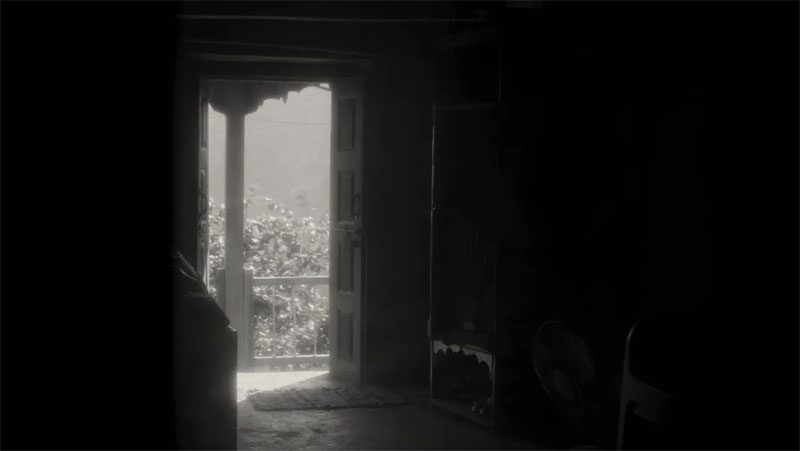
The cinematography, by Chetan Kapri, is extraordinary. Shot in black and white, the film finds an astonishing visual language for its memories and emotions. The Himalayan landscape is never simply a beautiful backdrop. Mountains, trees, open spaces, shifting light and the movement of wind seem to hold feelings that the filmmaker cannot always express through words. There is a remarkable attention to composition, with images that often resemble paintings without ever feeling overly arranged. The camera moves gently through the landscape, observing its textures and quiet rhythms. A tree standing against the sky, the changing shades of light, the stillness of a room or the vastness of the mountains gradually become connected to the filmmaker's inner world. The images carry a certain loneliness, but
there is also tenderness in the way they observe the world around her father. It is as if the landscape has quietly absorbed the years that separate them.
The decision to remain in black and white for almost the entire film makes the eventual appearance of colour particularly affecting. Towards the end, fragments of childhood footage bring us closer to a time when her father was still present in her life. These images carry a different kind of intimacy. They do not simply provide information about the past; they allow us to briefly encounter a world that once existed and can no longer be returned to. The contrast between these fragments and the carefully composed monochrome images gives the ending an emotional weight that feels entirely earned. Colour arrives quietly, but its presence is difficult to forget.
Sound is equally important to the film's atmosphere. The wind, the surrounding voices and the silences of the village give the images a life beyond their visual beauty. There is no need to fill every moment with music or explanation. The natural sounds allow us to inhabit the spaces the filmmaker visits, while the spoken and written words give shape to memories that remain complicated. The film understands that certain feelings are better approached gradually, through images and sounds that leave room for the audience to think and feel.
At just fifteen minutes, Six Weeks, 3 Days, and All the Years Before carries an emotional and visual richness that stays with you long after it ends. Its brevity never makes the experience feel incomplete. If anything, the film understands the value of leaving certain things unresolved. Ankita does not attempt to explain her father entirely, nor does she turn her own pain into an easy lesson about forgiveness. She simply returns to a relationship, looks at it from the perspective of someone about to become a parent, and allows the memories to find their own place.
What makes the film so beautiful is the way it brings together two different measures of time: the six weeks and three days of a new life, and all the years that came before it. Between them lies a daughter's attempt to understand where she comes from and what she might carry forward. It is a film about fathers and daughters, but also about the strange ways in which absence becomes part of our inheritance. Some distances cannot be measured by geography, and some memories never really leave us. With remarkable sensitivity, beautiful cinematography and a deeply personal sense of cinematic expression, Ankita Gusain has made a film that feels both intimate and universal. A small, precious work of cinema, and one that I find difficult to let go of.