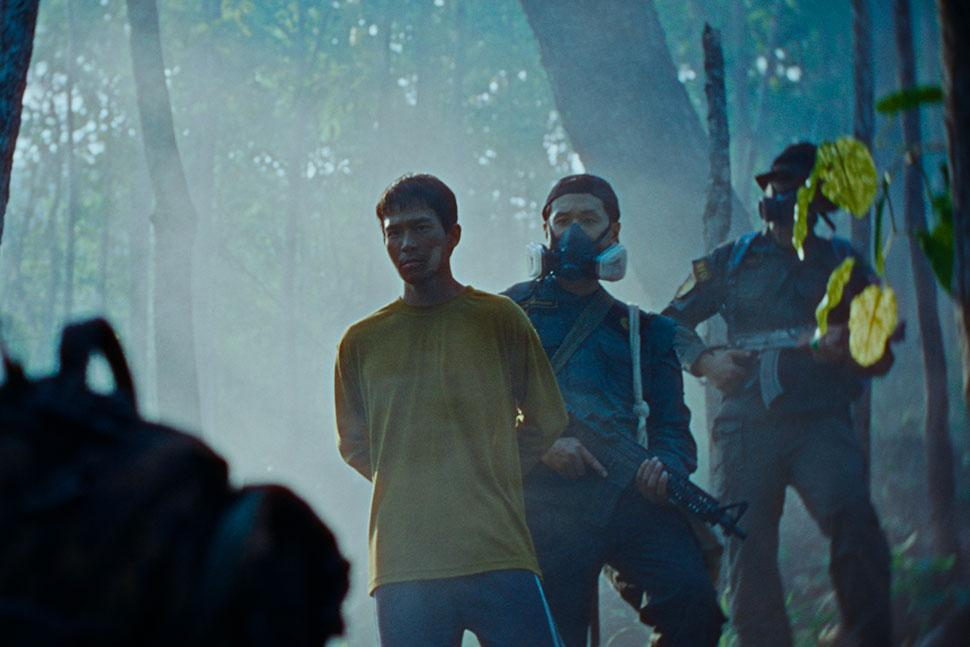
Phuttiphong Aroonpheng’s The Burning Giants (Yak Mai) has one of the best opening sequences at this year's Venice. Smoke hangs over a remote forest in western Thailand, the landscape is beautiful but strangely threatening, and very quickly there is a sense that something is terribly wrong. A mysterious illness is spreading, people are being displaced, and the forest seems to be holding a secret of its own. The film pulls you into this world almost immediately.
The story follows a Karen man who is taken to a quarantine centre after becoming infected by the mysterious disease. His wife, who has been living in Bangkok, tries to find a way back to him and to the home they have lost. Meanwhile, the authorities are preparing to destroy their village as part of the creation of a national park. What initially looks like a story about an unexplained disease gradually opens into something much more political, drawing on the persecution of Karen communities and the real-life disappearance of Karen activist Billy.
But Aroonpheng is not interested in telling this story realistically. The film keeps slipping between reality, memory and myth. The smoke feels almost supernatural, the illness takes on an otherworldly quality, and the forest becomes a place where different histories seem to exist at the same time. There are stories of soldiers fleeing an ancient king, ghosts of those who have disappeared, and a present-day community being pushed away from its own land. These elements do not always fit together neatly, but that uncertainty is part of the film's atmosphere.
The theatre sequence is perhaps the film's most memorable detour. It feels like stumbling upon another world entirely. Inside, performance and history begin to overlap, with an old story of soldiers and violence echoing the fate of the people who have been displaced in the present. The theatre is an unusual setting, but it gives Aroonpheng a way of bringing the past into the same physical space as the present. History is no longer something distant; it is being performed again, in front of us, in a place that has itself been abandoned.
The film is also visually stunning. The colour grading is one of its strongest elements. Deep greens, muted reds, heavy shadows and the pale haze of the smoke give the forest an almost dreamlike appearance. There is always a tension between the beauty of the landscape and what is happening inside it. The forest is home to the villagers, but it is also the territory the authorities want to control. Aroonpheng lets that contradiction sit inside the images rather than constantly explaining it.
Some of the quieter moments are particularly effective. The wife moving through the remains of the village carries a sadness that does not need much dialogue. In one striking scene, she sings inside an empty house, while elsewhere her husband is confined to his bed. The distance between them becomes almost impossible to measure: geographical, emotional and perhaps even spiritual.
There is a clear connection here to Aroonpheng's Manta Ray, another film concerned with borders, displacement and people who exist on the margins of society. But The Burning Giants is more ambitious and more openly political. It wants to connect contemporary violence with older stories, personal grief with collective memory, and the destruction of a village with the destruction of the stories attached to it.
The ambition does not always pay off. The film's opening is so strong, and its visual world so immediately compelling, that the later sections have difficulty sustaining the same force. As the mythology becomes more prominent, the narrative begins to feel less focused. There are ideas here that are intriguing but never fully developed, and the ending in particular feels weaker than what comes before. By that point, it can feel as though Aroonpheng has exhausted some of the possibilities he established so confidently at the beginning.
Still, The Burning Giants remains a striking piece of filmmaking. Its best moments are genuinely haunting, and its images stay with you long after the story becomes harder to follow. The smoke, the forest, the abandoned theatre and the traces of a community that has been erased all contribute to a world that feels simultaneously beautiful and wounded.
Aroonpheng does not make an easy political film, nor does he offer a straightforward explanation for the strange events taking place. Sometimes the film reaches further than it can quite hold together. But when its images, politics and mythology come together, The Burning Giants becomes something rare: a ghost story about displacement, where the ghosts are not only the dead, but also the people and histories that powerful institutions would rather see forgotten.