How do you explain yourself to yourself? Through a series of three interviews, Bae, an actress returning to the screen after a period away, grapples with portraying an identity to strangers that aligns with who she was, who she is now, and who she could be. As the audience orients itself, seemingly, Bae is too. Through her anecdotes, we learn of her past marriage, her relationship to alcohol, and her views on art. It’s sleight of hand in a script. The trio of interviewers vary in their levels of greenness, but each is considerably younger than Bae, and their questions often overlap, covering similar territory: Why did she return? What message does she have for young people?
Here, Bae is given the opportunity to edit in her repetition, to change the way she is perceived through simple syntactical alteration. Sang-soo places the mysterious core of his film here: it is through dialogue with others that the self comes into clarity—through which memories we share, which we choose to hide, and how we alter them in the retelling. Bae grapples with her divorce, bristling when the first interviewer mentions it, but with the second—a self-admitted imposter of sorts, there mostly for the opportunity to meet Bae—she opens up. Her understanding of love begins to take shape. Her ex-husband, she says, believed she was asking for too much, that everyone else simply makes do. Her eyes pool, but the meniscus holds.
Sang-soo strips away the flourishes synonymous with contemporary filmmaking and reveals the bare bones of the medium. Fewer than twenty shots, mostly static, showcase a woman in the process of becoming, untangling how language not only colors interpretation but produces it.
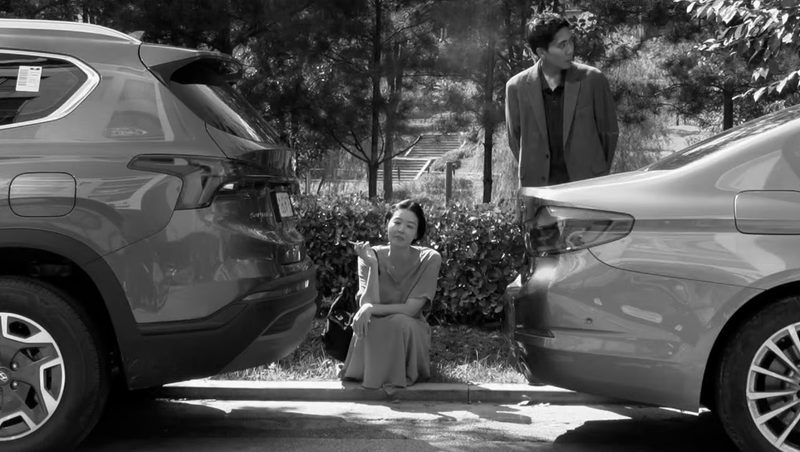
Bae fixates on the interviewers’ impressions of her film. She fishes for compliments, lavishing praise on the second interviewer, whom she finds beautiful. There is a pause before the words are mirrored back to her. It is a small exchange, but one that seems to contain the film in miniature: Bae sends something outward and waits to see what returns. The first interviewer, when offered a drink, politely declines even after Bae presses her. The second acquiesces easily. The third puts up no resistance. When the first refuses, Bae shares her past struggles with drinking, saying that had it not been for the birth of her daughter, she’d likely have died a lonely alcoholic. She says drinking is something in her past, something, perhaps, like her acting career.
After her final interview, Bae attends an acting class. She is tasked with turning the interviews from earlier that day into a script to be performed with a scene partner. Conversation can be exhausting, and when Bae’s amalgamated script falters, it becomes apparent that her rewrites, minute as they are, have robbed the dialogue of something true. “It is unfair to him” becomes “we are all entitled to our privacy”—a small, intimate truth transformed into the sweeping generality of a magnanimous figure. The change from person to performance.
Bae forgets her own lines, ones spoken only hours prior, not because she is an undisciplined actress, but because she is fighting against the particularity of what she said and the desire to be someone other than she is. Leaving the class, Bae and her instructor walk together, discussing the exercise. The instructor invites Bae to join her for a drink. Bae smiles and says her child will already be upset at how late she’s arriving home. They part ways.
Perhaps the self does not come into clarity through explanation at all, but through accumulation: the stories we repeat, the ones we revise, and the small choices we make when no one is asking us who we are. For all her effort to make herself legible, Bae is clearest here, in what she declines and where she decides to return.